7 Signs Your Team Must Digitize Its Sales

Every company starts the same way: an Excel file with contacts, a shared inbox, and a lot of goodwill. It works when you’re three people with 50 clients. But when the team grows and clients multiply, the seams start to tear. Here are 7 clear signs your team needs a sales platform — and what to do about each one.
Table of Contents
- 1. You don’t know how many open opportunities you have
- 2. Clients receive duplicate follow-ups (or none at all)
- 3. When a rep leaves, they take the information with them
- 4. You can’t predict next month’s revenue
- 5. Creating a quote takes more than 15 minutes
- 6. You don’t know which campaigns generate the most sales
- 7. Your clients ask for more transparency
- Digitize your sales process with Salesly
- Frequently asked questions
Key Takeaways
| Point | Details |
|---|---|
| Visibility gap | If answering “how many pending quotes do we have?” requires checking emails, you lack the centralized visibility a sales platform provides. |
| Duplicate efforts | Without a shared system, reps duplicate follow-ups or miss clients entirely, eroding credibility and wasting time. |
| Knowledge loss | When client knowledge lives only in reps’ heads, one resignation can erase years of relationships. |
| Revenue forecasting | A visual pipeline with weighted values replaces guesswork with realistic, data-backed revenue predictions. |
| Operational speed | Automating quote creation and campaign tracking frees hours every week for actual selling. |
1. You don’t know how many open opportunities you have
If the answer to “how many pending quotes do we have?” is “let me check my email,” you have a problem. A sales platform centralizes all opportunities with their value, stage, and assigned rep. The answer is one click away.
Without centralized tracking, opportunities fall through the cracks. Reps forget to follow up, managers can’t prioritize, and the team operates in the dark. A sales management platform gives everyone a single source of truth for every deal in the pipeline.
Pro tip: Start by mapping all your current open opportunities into a single view. You’ll likely discover deals you didn’t even know existed — and others that should have been closed weeks ago.
2. Clients receive duplicate follow-ups (or none at all)
When two reps call the same client on the same day — or worse, when nobody calls for weeks — you’re losing credibility. A sales management platform shows who talked to whom and when, preventing duplicates and oversights.

This isn’t just an internal efficiency issue — it directly affects how your clients perceive your company. Coordinated, timely follow-ups show professionalism. A platform with activity tracking and team visibility eliminates the chaos.
3. When a rep leaves, they take the information with them
If client knowledge lives in each rep’s head, you’re one resignation away from losing years of relationships. A sales platform is the team’s collective memory: notes, email history, sent quotes — everything is recorded.
New team members can pick up where their predecessors left off without missing a beat. The continuity of client relationships shouldn’t depend on any single person. Building a centralized knowledge base through your sales platform protects your most valuable asset: your client relationships.
Pro tip: Make it a habit to log every client interaction in the platform — calls, emails, meetings. What isn’t recorded doesn’t exist when someone new takes over the account.
4. You can’t predict next month’s revenue
Without a visual pipeline, predicting sales is placing bets. With a sales management platform, you sum each opportunity’s weighted value and get a realistic forecast you can present to management with confidence.
Accurate forecasting isn’t a luxury — it’s essential for inventory planning, hiring decisions, and cash flow management. Companies that adopt pipeline-based forecasting make better strategic decisions and avoid nasty surprises at quarter end.
5. Creating a quote takes more than 15 minutes
If every quote means opening Word, copying client data, looking up prices in another spreadsheet, and formatting manually, you’re wasting hours every week. In Salesly, you create a quote in under 3 minutes with pre-loaded contact and product data.
Speed matters beyond internal efficiency. The first company to send a professional quote often wins the deal. With a quoting tool integrated into your sales platform, you respond faster and look more professional.
6. You don’t know which campaigns generate the most sales
Without traceability between marketing campaigns and closed sales, you’re investing blindly. A sales platform connects each opportunity’s source to the final outcome, so you know where to invest more.
Understanding your return on investment per channel enables smarter budget allocation. Sales analytics reveal which campaigns deliver actual revenue — not just clicks or impressions — so you can double down on what works and cut what doesn’t.
Pro tip: Tag every new opportunity with its source channel from day one. After a few months, you’ll have the data to make marketing budget decisions with total confidence.
7. Your clients ask for more transparency
When a client asks “how’s my order going?” and the answer takes hours, the experience is poor. With a client portal like Salesly’s, your clients check the status of their quotes and orders in real time, without bothering your team.
Modern buyers expect self-service access to their information. A client portal reduces support requests, increases satisfaction, and positions your company as a digitally mature partner. It’s not a nice-to-have anymore — it’s what clients expect.
Digitize your sales process with Salesly
If you identified with 3 or more of these signs, it’s time to evaluate a sales management platform. You don’t need an oversized one with 200 features you’ll never use. You need one that adapts to your actual sales process and that your team can start using from day one.
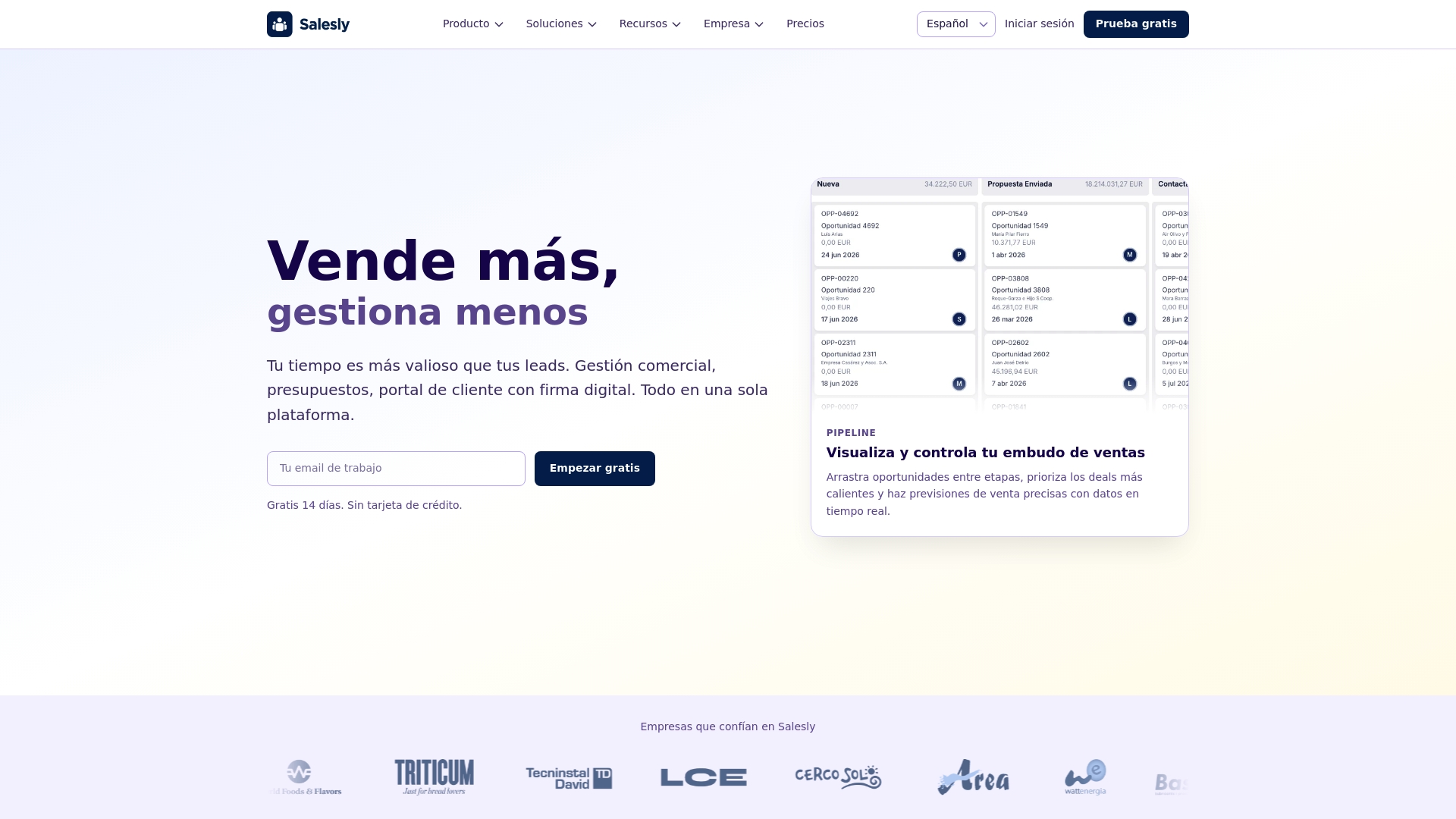
Salesly is designed exactly for this: sales teams of 5 to 50 people who need to centralize contacts, quotes, and orders without complications. Check our pricing plans to find the right fit, or explore all included features before deciding.
Frequently asked questions
How long does it take to implement a sales management platform?
Most teams can be fully operational within one to two weeks. The key is choosing a platform with an intuitive interface and pre-built configurations that reduce setup time. With Salesly, you can start entering contacts and opportunities from day one while customizing your pipeline stages in parallel.
Do I need to replace all my current tools at once?
No. A gradual approach works best. Start by centralizing your contacts and opportunities in the platform, then progressively move quoting, follow-up tracking, and reporting. This phased adoption reduces resistance and lets your team build confidence with the tool step by step.
What is the ROI of digitizing the sales process?
Companies that digitize their sales processes typically see a 20-30% increase in productivity, faster quote turnaround, and more accurate revenue forecasting. The time saved on manual tasks alone — searching emails, formatting quotes, compiling reports — often justifies the investment within the first quarter.
Is a sales platform suitable for small teams?
Absolutely. In fact, small teams benefit the most because they can’t afford the inefficiencies of manual processes. A platform designed for teams of 5 to 50 people, like Salesly, provides enterprise-grade visibility without the complexity or cost of solutions built for large corporations.
Related articles
The future of CRM with artificial intelligence
Discover how AI is redefining modern CRM: automation, predictive analytics, and personalized experiences for sales teams that drive real results.
CRM and VeriFactu: preparing your sales process for electronic invoicing in Spain
VeriFactu will be mandatory in Spain by 2026. Learn how a sales platform with ERP integration helps you comply without changing your sales workflow.
What Is Sales Management: A Practical Guide for 2026
Learn what sales management is, its strategic functions, and how to optimize it through digitalization. A complete guide with best practices for 2026.