What Is Sales Management: A Practical Guide for 2026

Modern sales management has evolved far beyond simply increasing revenue. Today, successful sales directors combine strategy, technology, and data analysis to build sustainable and profitable processes. This guide defines what sales management is, its strategic functions, and how to optimize it through digitalization. You will learn key concepts, current challenges, and best practices to transform your sales department in 2026.
Table of Contents
- What is sales management and what is its strategic role
- Digital transformation and data analysis in sales management
- Challenges and best practices in sales management digitalization
- Designing and optimizing sales processes for 2026
- Optimize your sales management with Salesly
- Frequently asked questions
Key Takeaways
| Point | Details |
|---|---|
| Strategic functions | Sales management encompasses the planning, coordination, and supervision of all sales activities to generate sustainable revenue. |
| Digital transformation | Companies that leverage data analytics report 25-30% improvements in lead generation and customer retention. |
| Implementation challenges | Technology integration requires change management, ongoing training, and compliance with privacy regulations. |
| Optimized processes | A well-defined sales process increases revenue by up to 28% and significantly improves customer experience. |
| Analysis and decisions | The combination of sales platform, automation, and key metrics transforms decision-making from intuition-based to evidence-based. |
What is sales management and what is its strategic role
Sales management is the set of strategic and operational activities designed to generate sustainable revenue and develop markets. Sales leadership plans, coordinates, and oversees all selling activities, serving as the engine that drives business growth.
This discipline goes well beyond the traditional sales department. It is a cross-functional capability that connects marketing, operations, finance, and customer service to create continuous value.
Key functions include:
- Strategic sales planning and setting measurable objectives
- Selecting and managing optimal distribution channels
- Customer segmentation and designing differentiated commercial policies
- Supervising the sales team and optimizing their performance
- Market analysis and adapting strategies according to trends
Effective sales management requires balancing strategic vision with tactical execution. Sales directors must anticipate market shifts, identify opportunities, and allocate resources where they generate the greatest impact. This combination of planning and action makes sales management a cornerstone of business success.
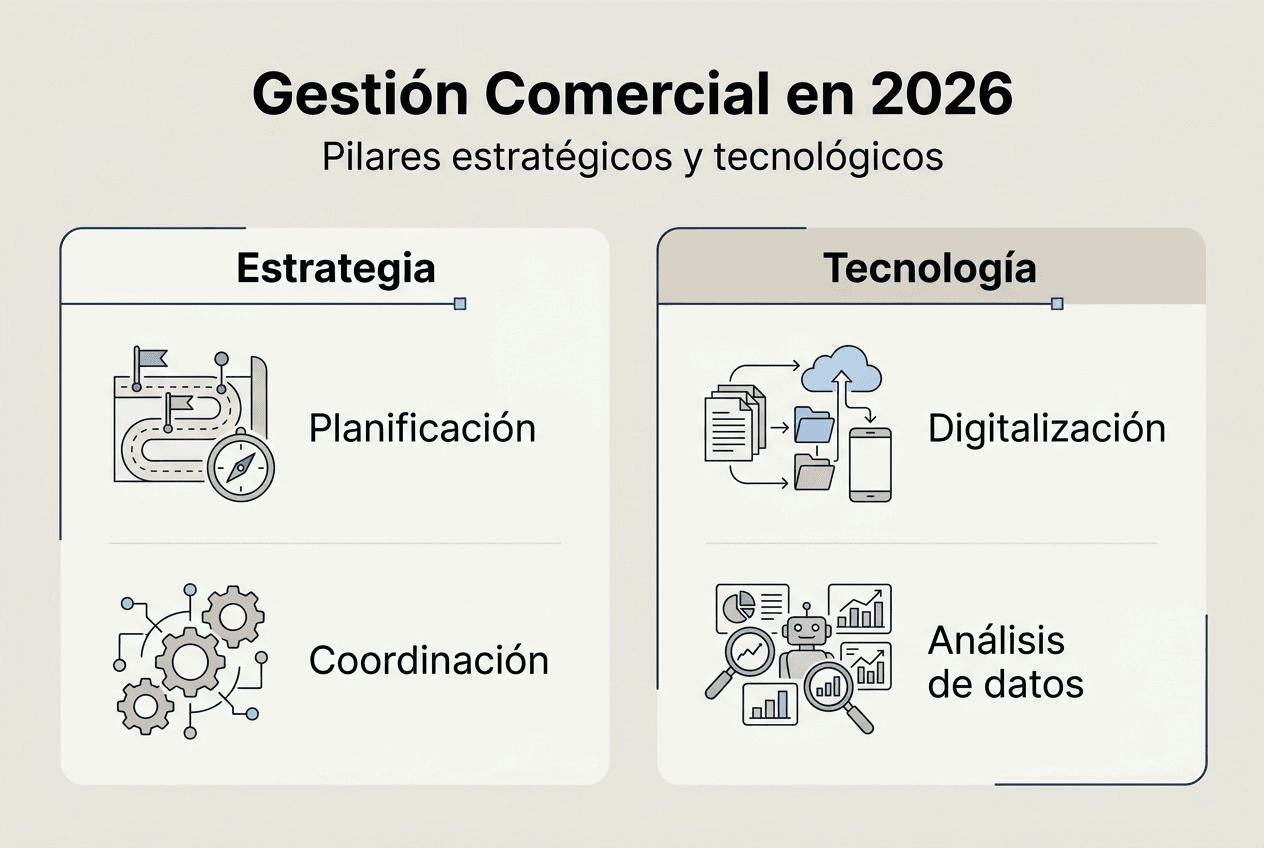
By 2026, solutions for sales teams integrate these functions into unified platforms that facilitate real-time coordination and tracking.
Pro tip: Define specific key performance indicators (KPIs) for each sales function. This allows you to measure effectiveness and adjust strategies with agility.
Digital transformation and data analysis in sales management
Digitalization is revolutionizing how companies interact with customers and manage their sales processes. Organizations that leverage data analytics report 25-30% improvements in lead generation and 20-25% increases in customer lifetime value.

Data analysis transforms commercial decision-making from intuition-based to evidence-based. Sales directors now access precise information about customer behavior, campaign effectiveness, and team performance. This visibility enables them to identify patterns, predict trends, and optimize strategies in real time.
Key technologies driving this transformation include:
- Sales management platforms that centralize customer information and automate follow-ups
- Automation tools that eliminate repetitive tasks and accelerate processes
- Predictive analytics platforms that anticipate needs and behaviors
- Digital portals that facilitate interaction and frictionless document signing
- Geolocation tools that optimize routes and territory assignments for the team
Sales platform implementation increases sales productivity by up to 26.4%, shortening sales cycles and improving conversion rates. This efficiency translates directly into higher revenue and better customer experience.
Concrete benefits include shorter sales cycles, better prospect targeting, increased customer retention, and the ability to personalize offers at scale. Data-driven sales analytics helps identify which strategies work and which require immediate adjustments.
Pro tip: Technology alone does not guarantee results. Combine your investment in Salesly’s sales management solution with team training and a cultural shift toward data-driven decision-making.
Challenges and best practices in sales management digitalization
Digital transformation presents significant obstacles that require strategic planning and active management. Challenges include data privacy, integration with legacy systems, and the need for continuous training of the sales team.
The main challenges are:
-
Data protection and legal compliance: Regulations such as GDPR and CCPA demand robust data management processes. Non-compliance leads to severe penalties and reputational damage.
-
Technology integration: Connecting new platforms with existing systems prevents information silos. Compatibility between tools determines the success of digitalization.
-
Training and cultural change: Inadequate planning and resistance to change cause 70% of digital transformations to fail. The team needs to understand the benefits and develop new competencies.
-
Strategic planning: Transformation requires a clear vision, adequate resources, and committed executive leadership. Projects without executive sponsorship rarely succeed.
-
Tool selection: The market offers multiple options that can feel overwhelming. Choosing scalable and easy-to-adopt solutions accelerates results.
To overcome these obstacles, implement a change management plan that includes transparent communication, hands-on training, and early wins that demonstrate value. Improving client management starts with gradual adoption and ongoing support.
Establish a digital transformation committee with representatives from sales, IT, legal, and management. This team coordinates efforts, resolves conflicts, and keeps the project focused on business objectives.
Pro tip: Prioritize intuitive solutions that reduce the learning curve. Excessive technical complexity generates frustration and slows adoption by the sales team.
Designing and optimizing sales processes for 2026
A well-defined sales process increases revenue by up to 28% and significantly improves customer satisfaction. The alignment between strategic planning and operational execution determines sustainable commercial results.
Effective processes share key characteristics: simplicity, adaptability, and a customer-centric focus. Every stage should add value without creating bottlenecks that slow the progress of opportunities.
The fundamental stages include:
- Initial contact: Identifying and qualifying prospects through multiple channels
- Qualification: Assessing needs, budget, and decision-making authority
- Proposal: Presenting personalized solutions with clear value
- Negotiation: Handling objections and making adjustments to close the deal
- Closing: Signing contracts and formalizing commitment
- Post-sale: Onboarding, support, and building a long-term relationship
Comparing traditional and digital models reveals clear advantages:
| Aspect | Traditional model | Digital model |
|---|---|---|
| Tracking | Manual, spreadsheets | Automated in sales platform, real-time |
| Visibility | Limited, weekly reports | Complete, live dashboards |
| Personalization | Generic by industry | Client-specific with data |
| Speed | Long cycles, multiple touchpoints | Shorter cycles, automation |
| Analysis | Retrospective, intuition-based | Predictive, evidence-based |
To keep processes optimized:
- Review and update stages quarterly based on team feedback
- Eliminate redundant steps that do not add value for the customer
- Automate administrative tasks to free up selling time
- Document best practices and share them across the entire team
- Measure conversion at each stage and identify areas for improvement
The sales pipeline: complete guide offers proven frameworks for structuring scalable processes. Solutions for the sales director integrate these methodologies into practical tools.
The key is to balance structure with flexibility. Rigid processes frustrate the team, while a complete lack of process creates chaos and unpredictable results.
Optimize your sales management with Salesly
Ready to transform your sales department with technology that truly works? Salesly offers a complete platform to digitalize processes, from prospecting to post-sale, all in one place.
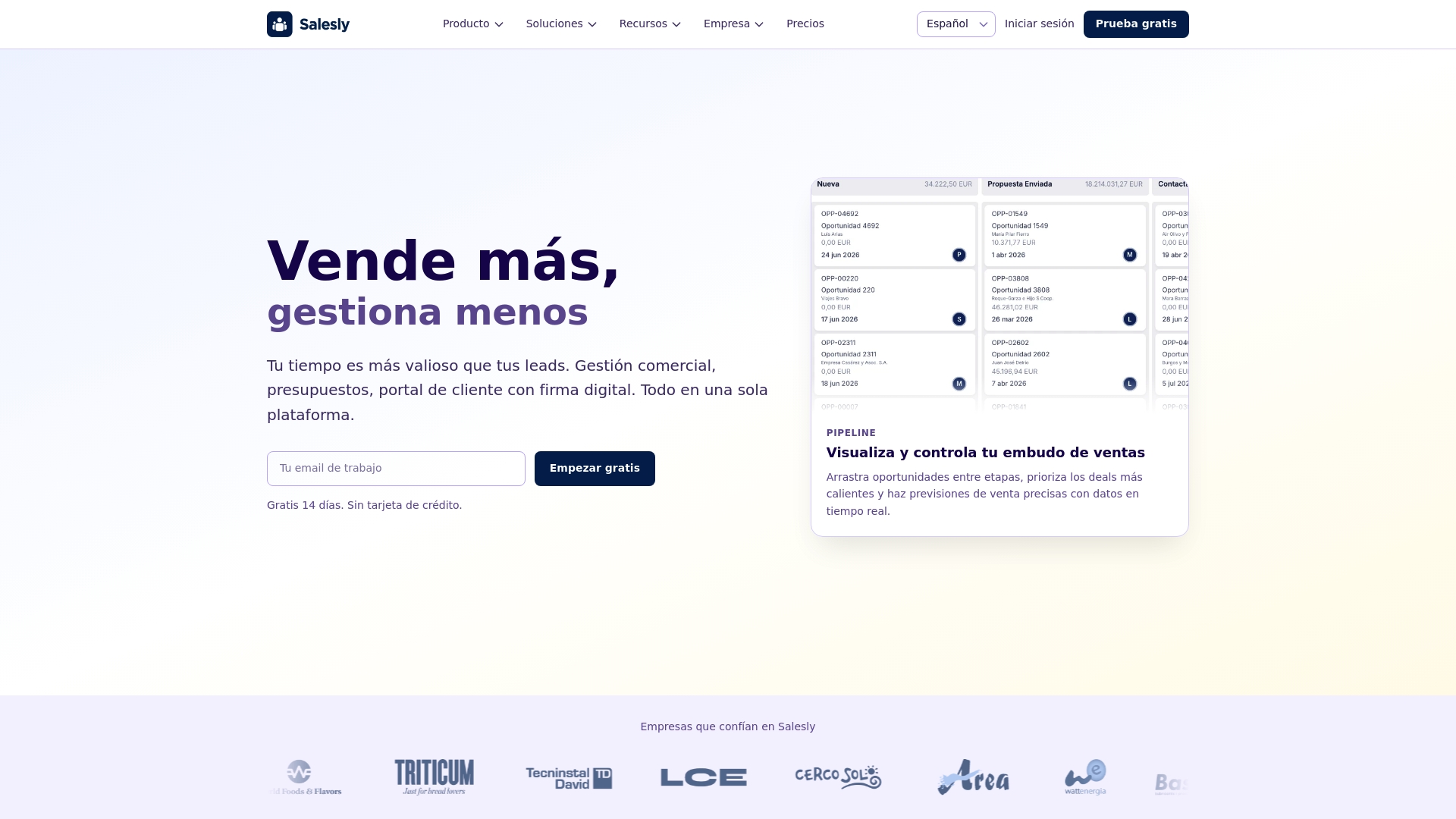
Our solution integrates sales management with a sales platform, visual pipeline, a client portal with digital signatures, team geolocation, and advanced analytics. Designed specifically for sales directors who seek efficiency, full control, and decisions based on real data.
With Salesly you eliminate information silos, automate repetitive tasks, and gain complete visibility into your sales operations. Thousands of companies already optimize their sales management with our solutions for the sales director, boosting productivity and improving results in measurable ways. Learn more about Salesly and how we can help you achieve your goals in 2026.
Frequently asked questions
What is the difference between sales management and selling?
Sales management is the strategic function that plans, coordinates, and oversees all revenue-related activities. Selling is one of those activities, focused on closing transactions. Sales management encompasses strategy, analysis, market development, and process optimization, while selling involves direct contact with customers.
How does data analysis influence modern sales management?
Data analysis transforms gut-feeling decisions into strategies based on concrete evidence. It enables the identification of behavioral patterns, prediction of future needs, and optimization of resource allocation. Data-driven sales analytics improves targeting, shortens sales cycles, and significantly increases conversion rates.
What are the main challenges when digitalizing sales processes?
The primary challenges include compliance with privacy regulations such as GDPR, integration with existing systems, and resistance to change within the team. Ongoing training, strategic planning, and committed executive leadership are essential to overcoming these obstacles. A well-designed change management plan minimizes resistance and accelerates adoption.
What characteristics should an effective sales process have in 2026?
An effective process should be simple, adaptable, and customer-centric. It should include clear stages from initial contact through post-sale, with specific metrics at each phase. Automating administrative tasks frees up time for higher-value activities. Flexibility allows adjustments based on market feedback without losing the fundamental structure.
Related articles
CRM and VeriFactu: preparing your sales process for electronic invoicing in Spain
VeriFactu will be mandatory in Spain by 2026. Learn how a sales platform with ERP integration helps you comply without changing your sales workflow.
The Future of Sales Platforms with AI
Discover how artificial intelligence is transforming sales platforms and redefining the sales process with AI agents, predictive analytics, and automation.
How to Create Sales Quotes That Convert
Quotes are your commercial calling card. Learn best practices for creating proposals your clients approve quickly.