CRM and VeriFactu: preparing your sales process for electronic invoicing in Spain

Electronic invoicing is no longer optional in Spain. With VeriFactu coming into force in mid-2026, thousands of SMEs will need to adapt their processes. If your sales team creates quotes that become orders and invoices, this change affects you directly. The good news: with the right integration between your sales platform and your ERP, compliance can be seamless.
Table of Contents
- Key takeaways
- What is VeriFactu and who does it affect?
- The impact on sales teams
- How a quote-to-order-to-invoice flow solves the problem
- What to look for in your sales platform
- Prepare your team with Salesly
- Frequently asked questions
Key takeaways
| Point | Details |
|---|---|
| VeriFactu will be mandatory in 2026 | Companies with revenue above €8M will be first; the rest will follow progressively. |
| It affects the entire sales flow | From quote to invoice, data must be traceable and reported to the Spanish Tax Agency in real time. |
| ERP integration is the key | If your sales platform syncs with your invoicing ERP, compliance is automatic. |
| You don’t need to change how you sell | With the right integration, your team keeps using their usual tool with no added friction. |
What is VeriFactu and who does it affect?
VeriFactu is Spain’s electronic invoice verification system, driven by the AEAT (Spanish Tax Agency). It requires invoicing software to send a record of each issued invoice to the tax authority in real time — or near real time.
Who does it affect?
- Phase 1 (mid-2026): Companies with annual revenue above €8 million.
- Phase 2 (later): All other businesses and freelancers, on a progressive timeline.
- Temporarily excluded: Businesses under simplified tax regimes and intra-community operations with their own e-invoicing.
If your company generates quotes that become orders and then invoices, you need the entire chain to be connected and traceable.
The impact on sales teams
Many sales teams think VeriFactu is “an admin problem.” But the impact starts much earlier:
- Quotes contain tax data that must be correct from the start (tax ID, legal name, VAT rate).
- Orders must match what is ultimately invoiced — discrepancies cause rejections.
- Timelines tighten because the invoice must be issued and reported to the AEAT almost in real time after delivery.
If your sales team uses one tool for quotes and a different one for invoicing, the risk of errors and inconsistencies multiplies.
Pro tip: Audit now how many times data from a quote is manually copied into an invoice. Every manual copy is a potential failure point under VeriFactu.
How a quote-to-order-to-invoice flow solves the problem
The solution isn’t to complicate the process, but to connect it. An integrated flow works like this:
- The sales rep creates a quote in the sales management platform with all the correct tax data.
- The client approves via the client portal with a digital signature.
- The quote converts to an order in one click — no retyping data.
- The order syncs to the ERP (Holded, Business Central) where the invoice is generated.
- The ERP issues the VeriFactu-compliant invoice with all data traceable from the source.
The result: the sales team doesn’t change how they work, and administration receives clean, consistent data for invoicing.
What to look for in your sales platform
Not all platforms are ready for this new reality. Here are the key capabilities:
Native ERP integration
Your sales tool must sync contacts, products, quotes and orders with your ERP. If the integration is manual (CSV exports, copy-pasting data), it won’t scale with VeriFactu.
Salesly integrates natively with Holded and Business Central, syncing data bidirectionally in real time.
Tax data from the first quote
The tax ID, legal name, fiscal address and VAT rate must be correct from the moment the sales rep creates the quote. Your platform should validate these fields and inherit them automatically from the contact record.
Full traceability
Every invoice must be traceable back to its original quote and order. This requires a connected flow, not loose documents in different tools.
Digital signature and online approval
The client portal with digital signature not only speeds up closing but generates an approval record that complements the traceability VeriFactu requires.
Prepare your team with Salesly
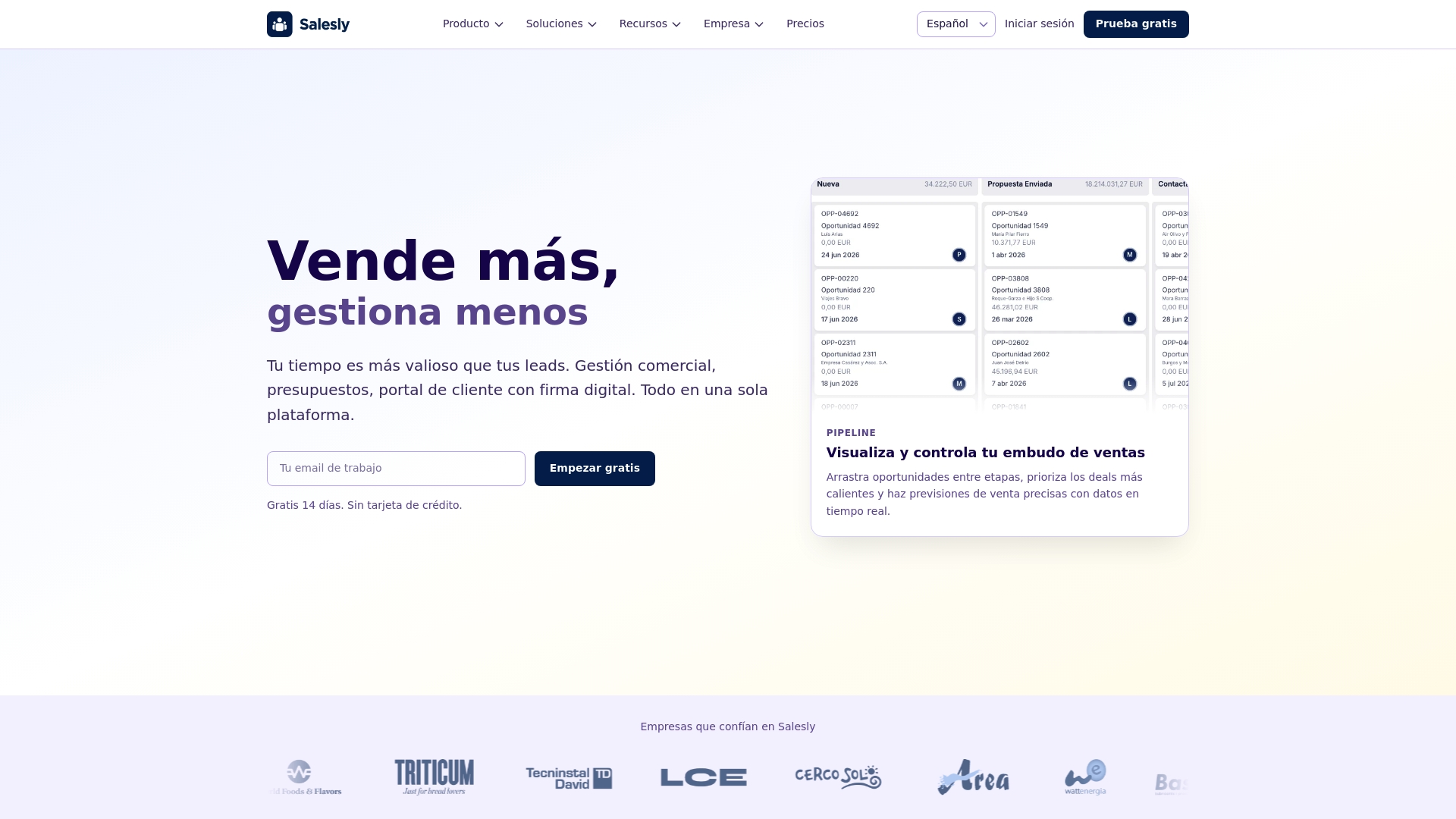
Salesly connects your sales process end to end: from quote to order, with native integration to your invoicing ERP. Your sales team keeps working as always, and administration receives clean data to generate VeriFactu-compliant invoices.
- Quotes with validated tax data
- Client portal with digital signature
- One-click conversion to order
- Automatic sync with Holded and Business Central
- Analytics dashboard to monitor the entire flow
Frequently asked questions
Does Salesly generate VeriFactu invoices directly?
No. Salesly manages the sales process up to the order stage. VeriFactu invoicing is handled by your ERP (Holded, Business Central) based on orders synced from Salesly. Each tool does what it does best.
What if my company isn’t required to comply with VeriFactu yet?
Even if your company isn’t in the first phase, preparing now has advantages: you avoid last-minute urgency, improve the quality of your sales data and reduce invoicing errors from day one.
Do I need to change my ERP to comply with VeriFactu?
Not necessarily. Most Spanish ERPs (Holded, A3, Sage) are updating their platforms to be VeriFactu-compatible. What matters is that your sales tool integrates correctly with your ERP so data flows without errors.
How does VeriFactu affect freelancers?
Freelancers will enter a later phase, but the principle is the same: they’ll need VeriFactu-compatible invoicing software. If you already use an integrated quote-to-order-to-invoice flow, the transition will be much smoother.
Related articles
What Is Sales Management: A Practical Guide for 2026
Learn what sales management is, its strategic functions, and how to optimize it through digitalization. A complete guide with best practices for 2026.
5 strategies to improve client management in your company
Discover how a modern sales platform can transform the way your sales team manages client relationships and closes more deals.
Sales Pipeline: Managing Your Sales Funnel
Learn how to design, implement, and optimize a sales pipeline that helps you close more deals and predict revenue with precision.